Start a conversation
Capricos — Operations Software

Most companies run on something nobody designed.

A Notion page, four spreadsheets and a group chat, held together by whoever remembers how it works. We replace it with one system built for how your business actually operates — and branded like everything else you own.

Scroll
4.9

89 reviews on Trustpilot — fifteen years of design work behind this, not a new software venture.

Reviewed publicly since 2019

This isn't a dashboard.

A dashboard shows you charts about data you already have somewhere else. Useful, occasionally. Not the problem.

What we build is the place the data comes from. The thing your team opens at nine in the morning and works inside all day — where the jobs live, where the clients live, where the work actually gets done.

What you have now
Tools that don't know about each other, and one person who knows where everything is.
What breaks first
Onboarding. A new hire can't be handed a system that only exists in someone's head.
What we build instead
One system, your logic, your brand, your permissions — that a new starter can be shown in an afternoon.
What gets built

Six things almost every system we build ends up needing.

Accounts, roles and permissions

Sign-in per person, not a shared password. An admin decides who sees what, and the boundaries match how your business is actually organised — not a plugin's three permission tiers.

replaces one login the whole team uses, and a sheet nobody is allowed to touch

The operational core

Clients, jobs, stock, bookings, cases, pipeline — whatever the nouns of your business are. Modelled properly once, so every part of the system agrees on what a client is.

replaces four spreadsheets that disagree with each other

Generated output

Proposals, listings, posts, reports — populated from data already in the system, with your brand rules applied automatically and a manual override on every individual item.

replaces a template file copied, renamed and edited by hand each time

Client-facing pages

Proposals and portals that live at a real URL with an editable slug, on your domain, and tell you when someone new has opened them.

replaces a PDF attached to an email you never hear about again

A brand pack the software reads from

Colours, type, logo and tone stored as settings the system applies everywhere. This is the part a dev shop doesn't build, and the reason what ships doesn't look like a generic admin panel.

replaces asking a designer to fix each export after the fact

The part after launch

Hosting, database, backups, security patches, and the changes you'll want once the business has moved on from the version you signed off. Software doesn't finish; it gets maintained or it rots.

replaces a freelancer who stopped answering

Previous client

The Mars Touch

Los Angeles · brand and content operation

A Los Angeles brand running its whole operation out of Notion. We replaced the workspace with a system of its own: team sign-in, admin-assigned roles, and every piece of content editable in place by the people who own it.

The security brief was strict — private repository, locked-down database access, invite-only sign-up and no public registration route at all. The design brief was luxury and Apple-quiet, which is the half a development shop would have handed back as a bare admin panel.

Presented to the team and adopted. It is what they open in the morning.

GitHub · Vercel · Supabase · originally launched as Pigmentouch

Inside the system
01 / 05
The Mars Touch sign-in screen
Sign inInvite-only. No public registration route exists.
The Mars Touch dashboard home
HomeWhat the team sees first, shaped by the role they signed in with.
The task list inside The Mars Touch dashboard
TasksContent edited in place by the people who own it, not filed as a request.
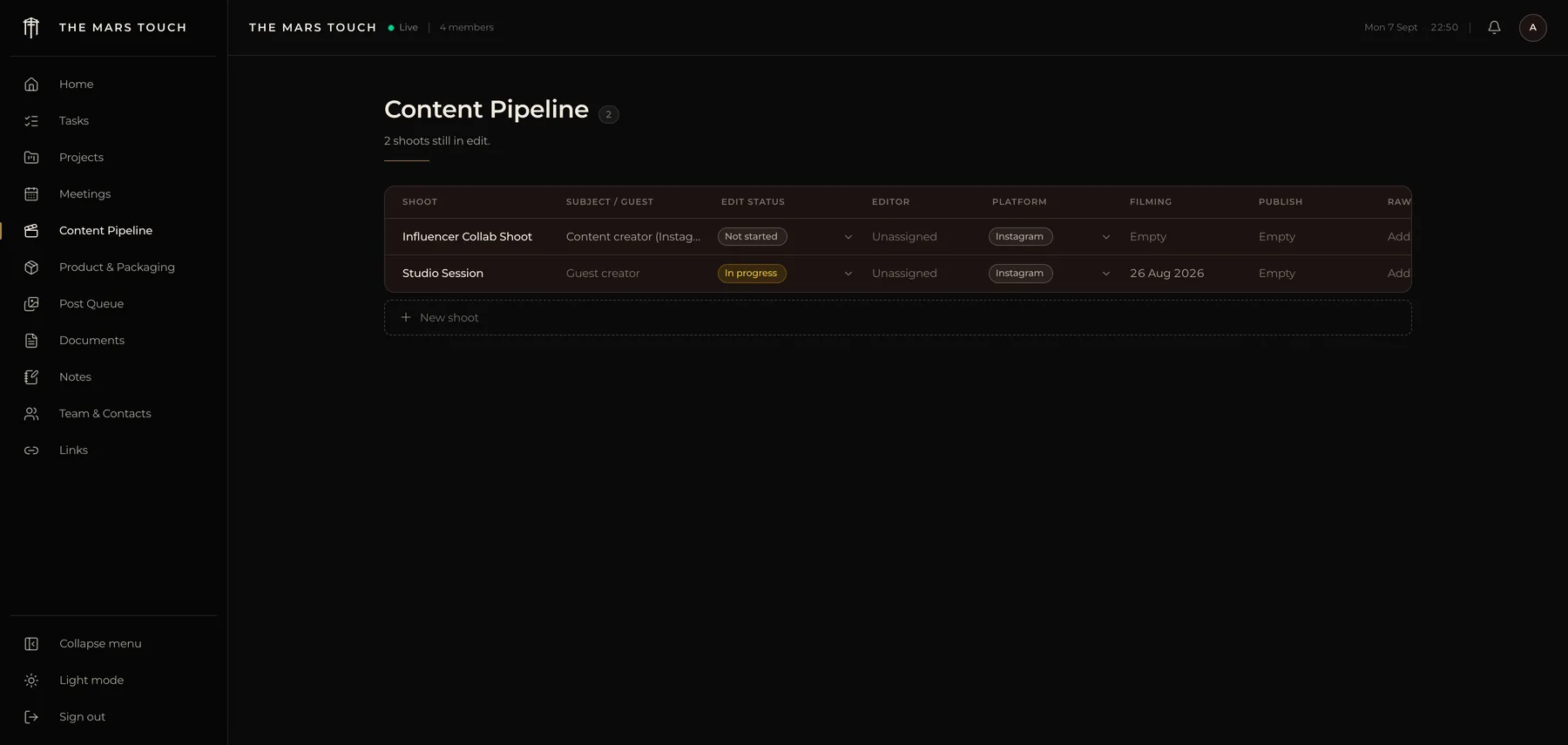
The content pipeline view inside The Mars Touch dashboard
Content pipelineEvery shoot, its edit stage, its platform and who is holding it.
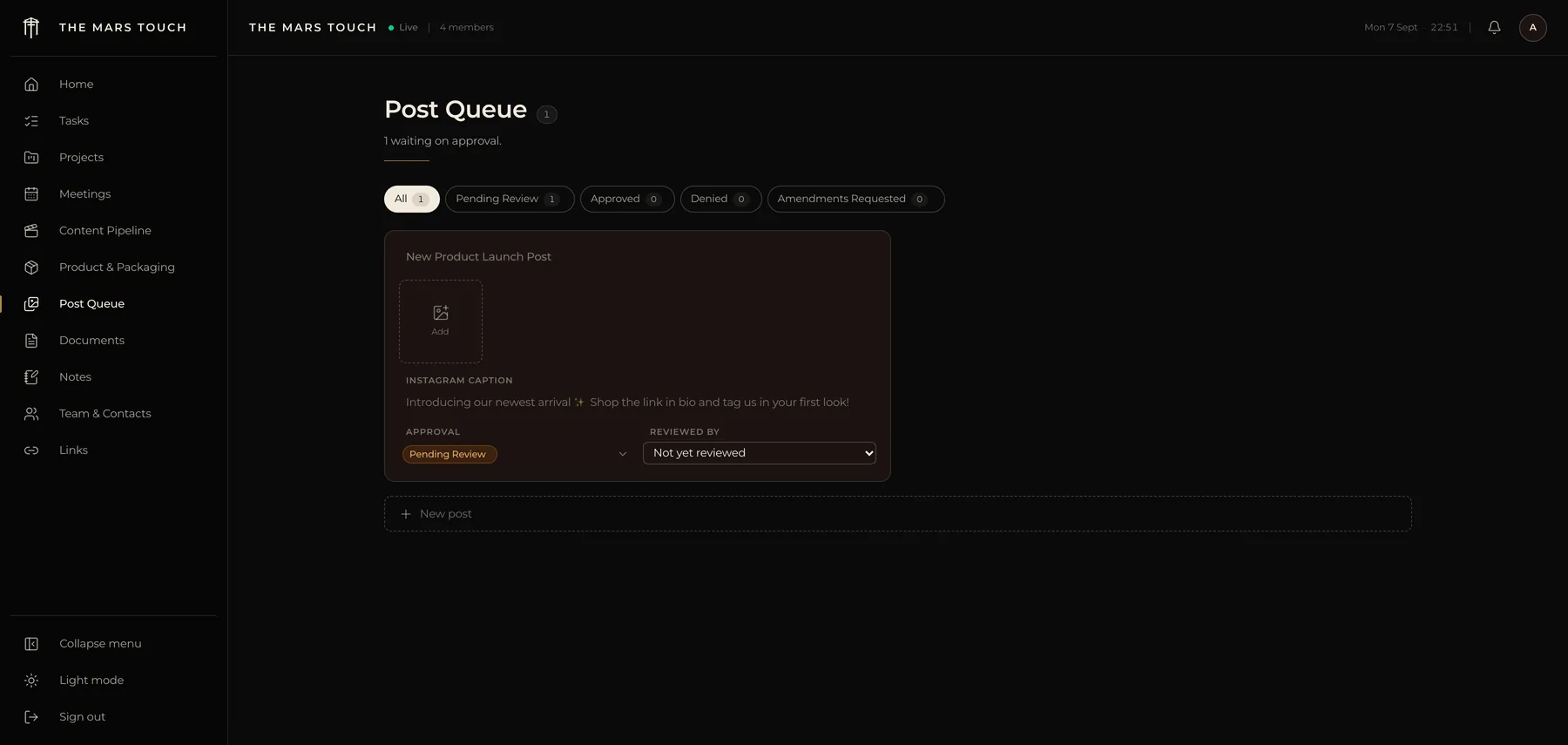
The post approval queue inside The Mars Touch dashboard
Post queueNothing publishes until the person who owns the brand approves it.
Where the confidence comes from
15Years designing — ten of them trading as Capricos
4.9Trustpilot rating across 89 reviews
12Systems and tools designed, built and running
1 personPerson you deal with — first call, build, and every change after it
How we work

Four stages, in this order, every time.

01

Map

A week inside how you work now. Every spreadsheet, every workaround, every thing someone does manually on a Friday. Most of the value of the finished system is decided here.

02

Design

Screens drawn and branded before a line of code exists. You sign off on what it looks like and how it flows while changing it is still cheap.

03

Build

Deployed early and often. You have a login and you're using the thing well before it's finished, which is how the wrong assumptions get caught.

04

Carry

Hosting, database, backups, security and a defined amount of change work every month. This part doesn't end, so it's priced as though it doesn't.

Your data

Answered before you ask.

If a system holds how your company runs, the questions about custody aren't paperwork — they're the deal. Here are our answers in writing, before the first call.

  • A data processing agreement, signed firstBefore anything of yours moves anywhere, in plain terms, naming what we hold and why.
  • You are told where it livesNamed provider, named region, in the contract — not "the cloud".
  • Private repositories, invite-only accountsNo public sign-up route exists on anything we build unless you ask for one.
  • You own the codeOn final payment, the repository transfers to you. There's no version of this where leaving costs you the system.
  • A written exit planYour data exported in a format you can actually use, whenever you ask, without a conversation about it first.
How it's priced

Two numbers, and you get both on the first call.

A one-off build fee, scoped to how much of your operation the system has to hold. A booking tool for one location and a system running four departments are not the same job, and pretending otherwise with a headline price would only mean quoting one of them wrong.

A monthly, which is not optional. It covers hosting, the database, backups, security updates and a defined amount of change work. Software that nobody is paid to maintain quietly becomes a liability about eighteen months in, and we'd rather price honestly for that than discover it together.

We don't publish a figure because the honest answer depends on the first conversation. Have that conversation and you'll leave it with a real number — not a range engineered to get you on another call.

Common questions

The ones that come up first.

Often you shouldn't. If two tools do the job and your team is happy, keep them. The case for building starts when the joins between tools are the work — when someone re-types the same client into three places, when the reporting only exists because a person assembles it every Monday, or when nobody can be onboarded without shadowing you for a fortnight. That's what we replace. Not software you like.

You do, on final payment — repository transferred, no licence conditions, no clause that makes leaving expensive. If you later want your own developer to take it over, that's a handover, not a negotiation.

The fair version of this question, and the reason for several of the choices above. You hold the repository. The stack is deliberately ordinary — a mainstream framework on mainstream hosting with a mainstream database — so any competent developer can pick it up without an archaeology phase. Nothing is built on a private tool of ours that only we understand. That's what makes a one-person studio a reasonable risk rather than an unreasonable one.

Mapping is about a week. Design is two to three. Build depends entirely on scope, but you have a working login early rather than at the end — the point is to be using it while it's still being built. A realistic total for a first system is measured in months, not weeks, and anyone promising otherwise is describing a template.

Hosting and database costs, backups, dependency and security updates, monitoring, and a defined block of change work — the small things every month that keep a system matching a business that keeps moving. It is written down as a number of hours, not implied goodwill.

That's the half most software teams skip. Bring guidelines and we'll build to them; bring a logo and some instincts and we'll do the branding work too — it is what this studio did for fifteen years before it built software. Either way the brand ends up stored in the system as settings, so what it generates is on-brand by construction rather than by review.

Build your spec.

Five short steps. At the end you'll see the spec you've just written, we'll get a copy, and you can put time in the calendar there and then.

Nothing here is binding. It exists so the first call starts at "here's what it would cost" rather than twenty minutes of background.

If it isn't a fit, we'll say so in the reply rather than book a call to tell you.

Step 1 of 5

What are you running on today?

Pick everything that applies.

Where does it hurt?

The two or three that cost you the most time.

Who's it for?

Roughly is fine.

In your words

One or two sentences. What would the system have to do for this to be worth it?

Where do we send it?

You'll get a copy of the spec at this address.

Spec received.

We'll read it properly before replying — usually the same day. If you'd rather not wait, put something in the calendar now.